|
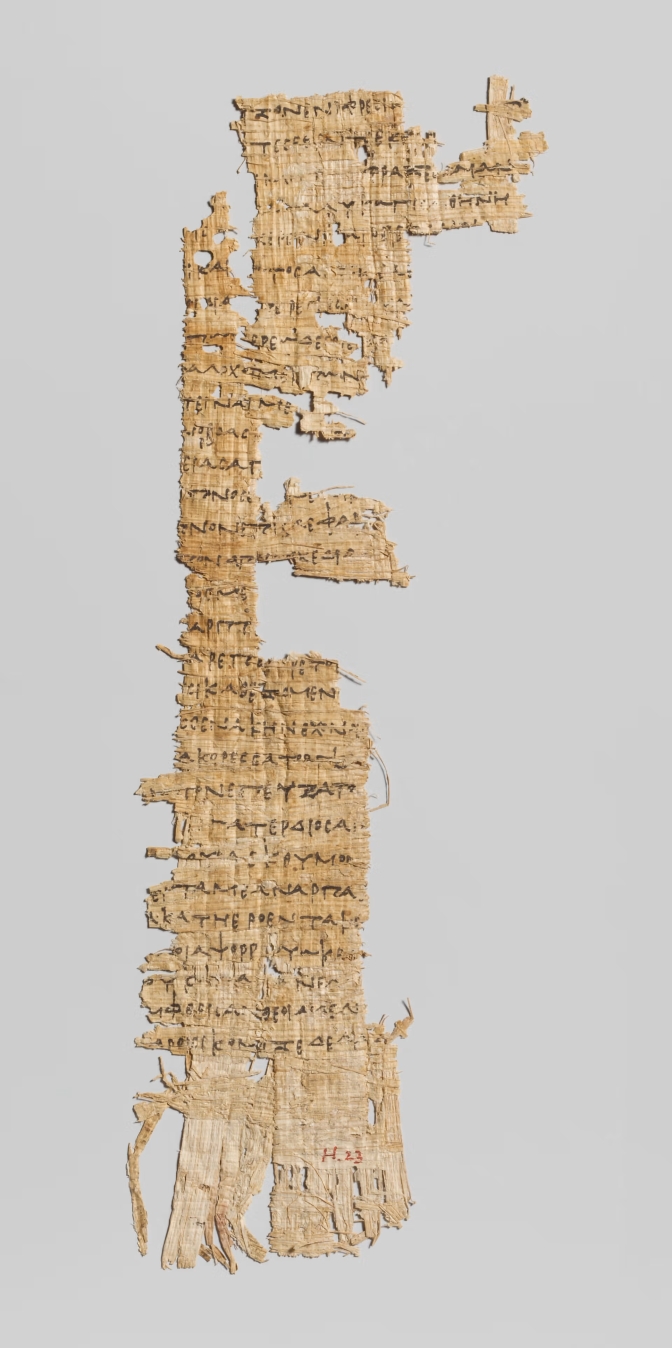
| Papyrus fragment with lines from The Odyssey, Hibeh (Egypt), ca. 285-250 BC |
This is the first early Ptolemaic fragment of The Odyssey ever discovered.
Circe’s warning to Odysseus in The Odyssey (Book 12, lines 52-53)
"ὄφρα κε τερπόμενος ὄπ᾽ ἀκούσῃς Σειρήνοιιν"
"...in order that you may delight in hearing the voice of the two Sirens."
The encounter with the Sirens in The Odyssey (Book 12, line 167)
"νῆσον Σειρήνοιιν· ἔπειγε γὰρ οὖρος ἀπήμων"
"...to the island of the two Sirens; for a harmless wind urged her on."
Circe’s warning to Odysseus in The Odyssey (Book 12, lines 45-46)
"Λειμῶδ᾽ ἀμφὶς δὲ ὀπέων μέγας ἄχθος ἀνδρῶν πυθομένων, περὶ δὲ ῥινοὶ μινύθουσι ὀστέοισιν"
"[The two Sirens] sitting in a meadow; around them lies a great heap of the bones of men who have rotted, and around the bones the skins waste away."
Buried beneath the heap of the back-dirt in the elite cemetery (HK6) at Hierakonpolis, Tomb 78 yielded the remains of two sub-adult tomb owners, aged 8 and 11–14 years respectively, whose bones were scattered throughout the fill.
The tomb yielded two distinct types of hair. One consisted of large clumps of thick, slightly kinky hair with some curls, apparently worn relatively short. These clumps contained numerous insects, probably attracted by oils or fats applied to the hair during life or during preparation for burial. The other type consisted of 15 artificial hair extensions, each originally about 14 cm long and made from two twisted locks ending in a small ringlet. Surviving portions of the wearer’s natural wavy hair revealed how the extensions had been attached. Slight differences in colour indicate that the extensions were made from someone else’s hair. The only other known example comes from HK43 Burial 16, although in that case the individual's own hair was reused.
On the tomb floor, pads of resin-soaked linen up to 1.5cm thick were discovered. Three layers of matting lined the floor, below which were sticks and larger pieces of wood up to 4cm square, possibly making up some kind of a bed.
Two black jars discovered in the tomb are imports from Lower Egypt. Yellowish residue on their interior suggests they were imported not for their looks but rather for their contents. The ceramic assemblage from the tomb indicates a date in the Naqada IIB period.
The ostrich feathers, found at the same level, were arranged in bundles of three, each slightly offset from the next and all oriented in the same direction. This suggests that they had been part of an ostrich feather fan.
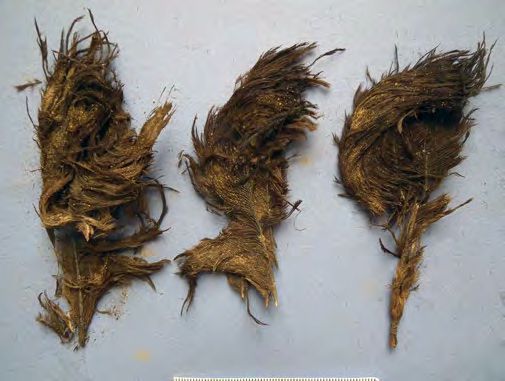 |
| Ostrich feathers (fragments of a fan) from HK6 Tomb 78 |
 |
| Beads made from Red Sea coral from HK6 Tomb 78 |
References:
https://www.metmuseum.org/art/collection/search/248134
https://www.hierakonpolis-online.org/files/hk_nn/nn-29-2017.pdf
July 23, 2026 Takahiko Nakagawa