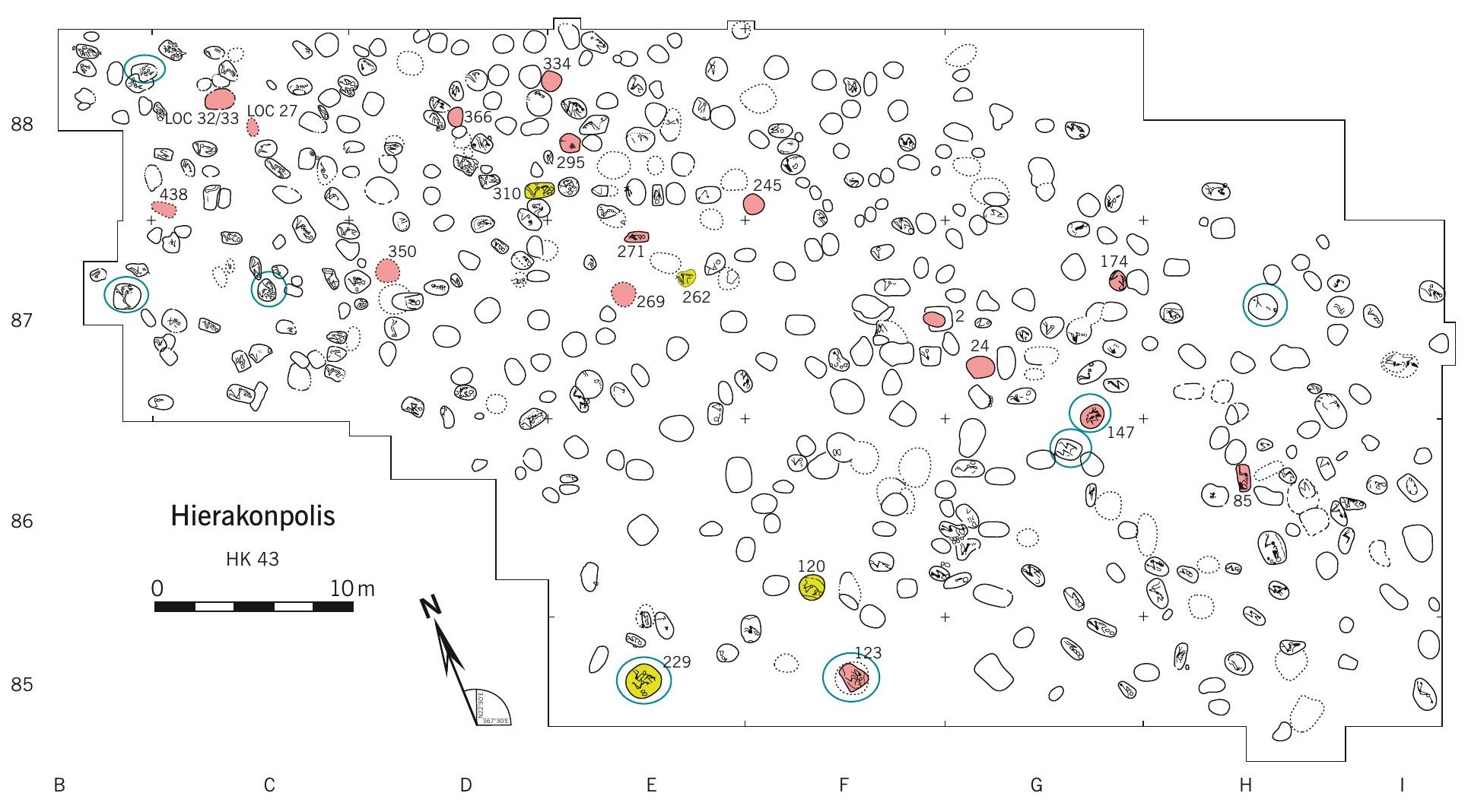
The cemetery called HK43, belonging to the non-elite (or workers) segment of the predynastic population, holds over 500 individuals of Naqada IIB-C period (roughly 3650-3500 BC). Excavations at HK43 have uncovered cutmarks found on the neck vertebrae of 21 individuals (from 15 graves and one disturbed cluster), indicating the cutting of the throat and in some cases, complete decapitation, five of whom (all young men) were also scalped. Of the 21 afected individuals, the majority that could be sexed were males (52 %, n = 11) and 9.5 % were females (n = 2), the rest being indeterminate. Most of the vertebral cut marks were located on the second, third, and fourth vertebrae and were inficted from the ventral aspect. However, none of the victims bore evidence of other violence or defensive wounds on their bodies. In contrast, several individuals suffered from fractured skulls, the result of severe blows to the head.
HK43 Burial 120, a circular grave, belonged to a woman (aged 35-40 years) found lying on her left side with both arms crossed over her chest and tree bark wrapped tightly around each of the limbs and torso. The bark is from Boswellia (frankincense) as the more likely. When clearing around the skull, it was found that half of the cranium was missing. After reconstructing the skull with pieces found some distance away, the woman had suffered a strong blow to the back left side of her head. As there is no evidence of healing, it would seem that this injury was the cause of death. The hair on the left side of the head had been cut off just above the level of the injury, apparently in an attempt to clean up the body. The remaining hair was then combed over to the intact right side of the skull to preserve a normal physical appearance. Further, although this grave was clearly undisturbed, the pottery within it was broken and scattered on either side of the body.
|
Burials with lacerated vertebrae are indicated in pink; burials with evidence of violent death in yellow. The blue circles indicate confirmed examples of concurrent multiple interments.
| Burial No. | Sex | Age | Location and Direction of Blow | Characteristics |
|---|---|---|---|---|
| B120 | Female | 35–40 yrs | Back Left Side of the Head | Strong blow to the cranium. Half of the cranium missing. |
| B262 | Female | 35–45 yrs | Back of the Head | Massive blunt force trauma; consistent with a blow from behind, possibly by a right-handed assailant. She was already nursing a fractured ulna. |
| B229 | Male | 30–35 yrs | Posterior and Medial aspect of the Right Parietal | Massive blunt force trauma; shape suggests an oblong weapon, possibly a mace head. |
| B310 | Male | 25–35 yrs | Left Parietal (1st blow, survived) → Right Parietal (2nd fatal blow) | Forceful impact caused the skull to shatter, with fragments embedded in brain tissue. Likely a blow from behind, possibly by a right-handed assailant. (Had a well-healed depression fracture from an earlier injury). |
| Burial No. | Sex | Age | Location and Direction of Blow | Characteristics |
|---|---|---|---|---|
| B339 | Child | 12–15 yrs | Left Frontal Bone (forehead) / Above Left Orbit | Depression fracture caused by a blunt, round object. Fully healed. |
| B358 | Child | 9–12 yrs | Back of the Head | Survived the blow. Specific location details not specified. |
| B375 | Female | 25–30 yrs | Front Right Side of the Head | Injury suffered during youth; showed the most significant amount of healing, surviving for many years. |
References:
http://www.hierakonpolis-online.org/index.php/nekhen-news
https://www.academia.edu/44756617/Pieri_A_Friedman_R_Dougherty_S_Ritual_Violence_in_Early_Egypt_A_view_from_Hierakonpolis
November 19, 2024 Takahiko Nakagawa